Combatting global grassland degradation
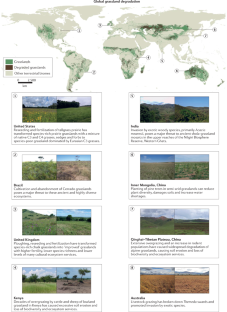
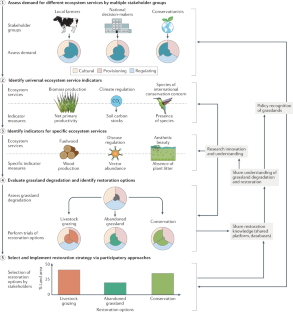
Grasslands are under severe threat from ongoing degradation, undermining their capacity to support biodiversity, ecosystem services and human well-being. Yet, grasslands are largely ignored in sustainable development agendas. In this Perspective, we examine the current state of global grasslands and explore the extent and dominant drivers of their degradation. Socio-ecological solutions are needed to combat degradation and promote restoration. Important strategies include: increasing recognition of grasslands in global policy; developing standardized indicators of degradation; using scientific innovation for effective restoration at regional and landscape scales; and enhancing knowledge transfer and data sharing on restoration experiences. Stakeholder needs can be balanced through standardized assessment and shared understanding of the potential ecosystem service trade-offs in degraded and restored grasslands. The integration of these actions into sustainability policy will aid in halting degradation and enhancing restoration success, and protect the socio-economic, cultural and ecological benefits that grasslands provide.
This is a preview of subscription content, access via your institution
Access options
Access Nature and 54 other Nature Portfolio journals
Get Nature+, our best-value online-access subscription
cancel any time
Subscribe to this journal
Receive 12 digital issues and online access to articles
133,45 € per year
only 11,12 € per issue
Buy this article
- Purchase on SpringerLink
- Instant access to full article PDF
Prices may be subject to local taxes which are calculated during checkout
Grassland changes and adaptive management on the Qinghai–Tibetan Plateau
Article 06 September 2022
Roles of the Red List of Ecosystems in the Kunming-Montreal Global Biodiversity Framework
Article 08 February 2024
Nexus of grazing management with plant and soil properties in northern China grasslands
Article Open access 04 February 2020
References
- Suttie, J. M. Reynolds, S. G. & Batello, C. Grasslands of the World (FAO, 2005).
- O’Mara, F. P. The role of grasslands in food security and climate change. Ann. Bot.110, 1263–1270 (2012). ArticleGoogle Scholar
- Wilsey, B. J. The Biology of Grasslands (Oxford Univ. Press, 2018).
- White, R. P. Murray, S., Rohweder, M., Prince, S. D. & Thompson, K. M. Grassland Ecosystems (World Resources Institute, 2000).
- Gibbs, H. K. & Salmon, J. M. Mapping the world’s degraded lands. Appl. Geogr.57, 12–21 (2015). ArticleGoogle Scholar
- Lark, T. J., Spawn, S. A., Bougie, M. & Gibbs, H. K. Cropland expansion in the United States produces marginal yields at high costs to wildlife. Nat. Commun.11, 4295 (2020). ArticleGoogle Scholar
- Abberton, M., Conant, R. & Batello, C. (eds) Grassland Carbon Sequestration: Management, Policy and Economics (FAO, 2010).
- Gang, C. et al. Quantitative assessment of the contributions of climate change and human activities on global grassland degradation. Environ. Earth Sci.72, 4273–4282 (2014). ArticleGoogle Scholar
- Dong, S., Kassam, K.-A. S., Tourrand, J. F. & Boone, R. B. (eds) Building Resilience of Human-Natural Systems of Pastoralism in the Developing World (Springer, 2016).
- Bengtsson, J. et al. Grasslands — more important for ecosystem services than you might think. Ecosphere10, e02582 (2019). ArticleGoogle Scholar
- Kwon, H. Y. et al. in Economics of Land Degradation and Improvement – A Global Assessment for Sustainable Development (eds Nkonya, E., Mirzabaev, A. & von Braun, J.) 197–214 (Springer, 2015).
- Murphy, B. P., Andersen, A. N. & Parr, C. L. The underestimated biodiversity of tropical grassy biomes. Philos. Trans. R. Soc. B371, 20150319 (2016). ArticleGoogle Scholar
- Smith, P. et al. Greenhouse gas mitigation in agriculture. Philos. Trans. R. Soc. B363, 789–813 (2008). ArticleGoogle Scholar
- Mermoz, S., Bouvet, A., Toan, T. L. & Herold, M. Impacts of the forest definitions adopted by African countries on carbon conservation. Environ. Res. Lett.13, 104014 (2018). ArticleGoogle Scholar
- Erdős, L. et al. The edge of two worlds: A new review and synthesis on Eurasian forest-steppes. Appl. Veg. Sci.21, 345–362 (2018). ArticleGoogle Scholar
- Dengler, J., Janišová, M., Török, P. & Wellstein, C. Biodiversity of Palaearctic grasslands: a synthesis. Agric. Ecosyst. Environ.182, 1–14 (2014). ArticleGoogle Scholar
- Bullock, J. M. et al. in The UK National Ecosystem Assessment Technical Report (UNEP-WCMC, 2011).
- Parr, C. L., Lehmann, C. E. R., Bond, W. J., Hoffmann, W. A. & Andersen, A. N. Tropical grassy biomes: misunderstood, neglected, and under threat. Trends Ecol. Evol.29, 205–213 (2014). ArticleGoogle Scholar
- Venter, Z. S., Cramer, M. D. & Hawkins, H. J. Drivers of woody plant encroachment over Africa. Nat. Commun.9, 2272 (2018). ArticleGoogle Scholar
- Palchan, D. & Torfstein, A. A drop in Sahara dust fluxes records the northern limits of the African Humid Period. Nat. Commun.10, 3803 (2019). ArticleGoogle Scholar
- Wilson, J. B., Peet, R. K., Dengler, J. & Pärtel, M. Plant species richness: the world records. J. Veg. Sci.23, 796–802 (2012). ArticleGoogle Scholar
- Eriksson, O. & Cousins, S. A. Historical landscape perspectives on grasslands in Sweden and the Baltic region. Land3, 300–321 (2014). ArticleGoogle Scholar
- Bråthen, K., Pugnaire. F. I. & Bardgett, R. D. The paradox of forbs in grasslands and their legacy of the Mammoth steppe. Front. Ecol. Environ. (in the press).
- Shava, S. & Masuku, S. Living currency: The multiple roles of livestock in livelihood sustenance and exchange in the context of rural indigenous communities in southern Africa. South. Afr. J. Environ. Educ.https://doi.org/10.4314/sajee.v35i1.16 (2019). ArticleGoogle Scholar
- FAO. Livestock Keepers – Guardians of Biodiversity (FAO, 2009).
- Bond, W. J. Ancient grasslands at risk. Science351, 120–122 (2016). ArticleGoogle Scholar
- Ripple, W. J. et al. Collapse of the world’s largest herbivores. Sci. Adv.1, e1400103 (2015). ArticleGoogle Scholar
- Arbieu, U., Grünewald, C., Martín-López, B., Schleuning, M. & Böhning-Gaese, K. Large mammal diversity matters for wildlife tourism in Southern African Protected Areas: Insights for management. Ecosyst. Serv.31, 481–490 (2018). ArticleGoogle Scholar
- Lavorel, S. et al. Historical trajectories in land use pattern and grassland ecosystem services in two European alpine landscapes. Reg. Environ. Change17, 2251–2264 (2017). ArticleGoogle Scholar
- Scurlock, J. M. O. & Hall, D. O. The global carbon sink: a grassland perspective. Glob. Change Biol.4, 229–233 (1998). ArticleGoogle Scholar
- Chang, J. et al. Climate warming from managed grasslands cancels the cooling effect of carbon sinks in sparsely grazed and natural grasslands. Nat. Commun.12, 118 (2021). ArticleGoogle Scholar
- Goldstein, A. Protecting irrecoverable carbon in Earth’s ecosystems. Nat. Clim. Change10, 287–295 (2020). ArticleGoogle Scholar
- Conant, R. T., Cerri, C. E., Osborne, B. B. & Paustian, K. Grassland management impacts on soil carbon stocks: a new synthesis. Ecol. Appl.27, 662–668 (2017). ArticleGoogle Scholar
- IPBES. The IPBES Assessment Report on Land Degradation and Restoration (IPBES, 2018).
- Cao, J. et al. Grassland degradation on the Qinghai-Tibetan Plateau: reevaluation of causative factors. Rangel. Ecol. Manag.72, 988–995 (2019). ArticleGoogle Scholar
- Andrade, B. O. et al. Grassland degradation and restoration: a conceptual framework of stages and thresholds illustrated by southern Brazilian grasslands. Nat. Conserv.13, 95–104 (2015). ArticleGoogle Scholar
- Okpara, U. T. et al. A social-ecological systems approach is necessary to achieve land degradation neutrality. Environ. Sci. Policy89, 59–66 (2018). ArticleGoogle Scholar
- Castro, A. J. et al. Ecosystem service trade-offs from supply to social demand: A landscape-scale spatial analysis. Landsc. Urban Plan.132, 102–110 (2014). ArticleGoogle Scholar
- Felipe-Lucia, M. R. et al. Ecosystem services flows: why stakeholders’ power relationships matter. PLoS One10, e0132232 (2015). ArticleGoogle Scholar
- Manning, P. et al. Redefining ecosystem multifunctionality. Nat. Ecol. Evol.2, 427–436 (2018). ArticleGoogle Scholar
- Wang, S. et al. Management and land use change effects on soil carbon in northern China’s grasslands: a synthesis. Agric. Ecosyst. Environ.142, 329–340 (2011). ArticleGoogle Scholar
- Allan, E. et al. Land use intensification alters ecosystem multifunctionality via loss of biodiversity and changes to functional composition. Ecol. Lett.18, 834–843 (2015). ArticleGoogle Scholar
- Bullock, J. M., Aronson, J., Newton, A. C., Pywell, R. F. & Rey-Benayas, J. M. Restoration of ecosystem services and biodiversity: conflicts and opportunities. Trends Ecol. Evol.26, 541–549 (2011). ArticleGoogle Scholar
- Ridding, L. E., Watson, S. C. L., Newton, A. C., Rowland, C. S. & Bullock, J. M. Ongoing, but slowing, habitat loss in a rural landscape over 85 years. Landsc. Ecol.35, 257–273 (2020). ArticleGoogle Scholar
- Hilker, T., Natsagdorj, E., Waring, R. H., Lyapustin, A. & Wang, Y. J. Satellite observed widespread decline in Mongolian grasslands largely due to overgrazing. Glob. Chang. Biol.20, 418–428 (2014). ArticleGoogle Scholar
- Poschlod, P. & WallisDeVries, M. F. The historical and socioeconomic perspective of calcareous grasslands - lessons from the distant and recent past. Biol. Conserv.104, 361–376 (2002). ArticleGoogle Scholar
- Stevens, C. J., Dise, N. B., Mountford, J. O. & Gowing, D. J. Impact of nitrogen deposition on the species richness of grasslands. Science303, 1876–1879 (2004). ArticleGoogle Scholar
- Aune, S., Bryn, A. & Hovstad, K. A. Loss of semi-natural grassland in a boreal landscape: impacts of agricultural intensification and abandonment. J. Land Use Sci.13, 375–390 (2018). ArticleGoogle Scholar
- Veldman, J. W. et al. Where tree planting and forest expansion are bad for biodiversity and ecosystem services. Bioscience65, 1011–1018 (2015). ArticleGoogle Scholar
- Shukla, P. R. et al. (eds) Climate Change and Land: An IPCC Special Report on Climate Change, Desertification, Land Degradation, Sustainable Land Management, Food Security, and Greenhouse Gas Fluxes in Terrestrial Ecosystems (CGIAR, 2019).
- Burrell, A. L., Evans, J. P. & De Kauwe, M. G. Anthropogenic climate change has driven over 5 million km 2 of drylands towards desertification. Nat. Commun.11, 3853 (2020). ArticleGoogle Scholar
- Archer, S. R. et al. in Rangeland Systems: Processes, Management and Challenges (ed. Briske, D. D.) 25–84 (Springer, 2017).
- Zhang, G. et al. Exacerbated grassland degradation and desertification in Central Asia during 2000–2014. Ecol. Appl.28, 442–456 (2018). ArticleGoogle Scholar
- Dudley, N. et al. Grassland and Savannah Ecosystems: An Urgent Need for Conservation and Sustainable Management (WWF Deutschland, 2020).
- Henderson, K. A. et al. Landowner perceptions of the value of natural forest and natural grassland in a mosaic ecosystem in southern Brazil. Sustain. Sci.11, 321–330 (2016). ArticleGoogle Scholar
- Costanza, R. et al. Changes in the global value of ecosystem services. Glob. Environ. Change26, 152–158 (2014). ArticleGoogle Scholar
- Durigan, G., Pilon, N. A. P., Assis, G. B., Souza, F. M. & Baitello, J. B. Plantas Pequenas do Cerrado: Biodiversidade Negligenciada. (Instituto Florestal, Secretaria do Meio Ambiente, 2018).
- Assandri, G., Bogliani, G., Pedrini, P. & Brambilla, M. Toward the next Common Agricultural Policy reform: Determinants of avian communities in hay meadows reveal current policy’s inadequacy for biodiversity conservation in grassland ecosystems. J. Appl. Ecol.56, 604–617 (2019). ArticleGoogle Scholar
- Liang, L., Chen, F., Shi, L. & Niu, S. NDVI-derived forest area change and its driving factors in China. PLoS One13, e0205885 (2018). ArticleGoogle Scholar
- Cao, S. et al. Damage caused to the environment by reforestation policies in arid and semi-arid areas of China. Ambio39, 279–283 (2010). ArticleGoogle Scholar
- Cao, S., Wang, G. & Chen, l Questionable value of planting thirsty trees in dry regions. Nature465, 31 (2010). ArticleGoogle Scholar
- Zastrow, M. China’s tree-planting drive could falter in a warming world. Nature573, 474–475 (2019). ArticleGoogle Scholar
- Landau, E., da Silva, G. A., Moura, L., Hirsch, A., & Guimaraes, D. Dinâmica da produção agropecuária e da paisagem natural no Brasil nas últimas décadas: sistemas agrícolas, paisagem natural e análise integrada do espaço rural (Embrapa Milho e Sorgo-Livro científico (ALICE), 2020).
- Wolff, S., Schrammeijer, E. A., Schulp, C. J. & Verburg, P. H. Meeting global land restoration and protection targets: What would the world look like in 2050? Glob. Environ. Change52, 259–272 (2018). ArticleGoogle Scholar
- Bastin, J. F. et al. The global tree restoration potential. Science365, 76–79 (2019). ArticleGoogle Scholar
- Veldman, J. W. et al. Comment on “The global tree restoration potential”. Science366, eaay7976 (2019). ArticleGoogle Scholar
- Dass, P., Houlton, B. Z., Wang, Y. & Warlind, D. Grasslands may be more reliable carbon sinks than forests in California. Environ. Res. Lett.13, 074027 (2018). ArticleGoogle Scholar
- Jackson, R. B., Banner, J. L., Jobbágy, E. G., Pockman, W. T. & Wall, D. H. Ecosystem carbon loss with woody plant invasion of grasslands. Nature418, 623–626 (2002). ArticleGoogle Scholar
- Jackson, R. B. et al. The ecology of soil carbon: pools, vulnerabilities, and biotic and abiotic controls. Annu. Rev. Ecol. Evol. Syst.48, 419–445 (2017). ArticleGoogle Scholar
- Berthrong, S. T., Jobbágy, E. G. & Jackson, R. B. A global meta-analysis of soil exchangeable cations, pH, carbon, and nitrogen with afforestation. Ecol. Appl.19, 2228–2241 (2009). ArticleGoogle Scholar
- Kirschbaum, M. U. F. et al. Implications of albedo changes following afforestation on the benefits of forests as carbon sinks. Biogeosciences8, 3687–3696 (2011). ArticleGoogle Scholar
- Conant, R. T. Challenges and Opportunities for Carbon Sequestration in Grassland Systems. A Technical Report on Grassland Management and Climate Change Mitigation (FAO, 2010).
- Wu, G. L. et al. Trade-off between vegetation type, soil erosion control and surface water in global semi-arid regions: A meta-analysis. J. Appl. Ecol.57, 875–885 (2020). ArticleGoogle Scholar
- Veldman, J. W. et al. Tyranny of trees in grassy biomes. Science347, 484–485 (2015). ArticleGoogle Scholar
- Burrascano, S. et al. Current European policies are unlikely to jointly foster carbon sequestration and protect biodiversity. Biol. Conserv.201, 370–376 (2016). ArticleGoogle Scholar
- Vanak, A. T., Hiremath, A. & Rai, N. Wastelands of the mind: Identity crisis of India’s tropical savannas. Curr. Conserv.7, 16–23 (2014). Google Scholar
- Ratnam, J., Tomlinson, K. W., Rasquinha, D. N. & Sankaran, M. Savannahs of Asia: antiquity, biogeography, and an uncertain future. Philos. Trans. R. Soc. B Biol. Sci.371, 20150305 (2016). ArticleGoogle Scholar
- Overbeck, G. E. et al. Conservation in Brazil needs to include non-forest ecosystems. Divers. Distrib.21, 1455–1460 (2015). ArticleGoogle Scholar
- Kumar, D. et al. Misinterpretation of Asian savannas as degraded forest can mislead management and conservation policy under climate change. Biol. Conserv.241, 108293 (2020). ArticleGoogle Scholar
- Kemp, D. R. et al. Innovative grassland management systems for environmental and livelihood benefits. Proc. Natl Acad. Sci. USA110, 8369–8374 (2013). ArticleGoogle Scholar
- Scholes, R. et al. (eds) Summary for Policymakers of the Assessment Report on Land Degradation and Restoration of the Intergovernmental Science-Policy Platform on Biodiversity and Ecosystem Services (IPBES Secretariat, 2018).
- Lamarque, P. et al. Stakeholder perceptions of grassland ecosystem services in relation to knowledge on soil fertility and biodiversity. Reg. Environ. Change11, 791–804 (2011). ArticleGoogle Scholar
- Hauck, J., Schmidt, J. & Werner, A. Using social network analysis to identify key stakeholders in agricultural biodiversity governance and related land-use decisions at regional and local level. Ecol. Soc.21, 49 (2016). ArticleGoogle Scholar
- Reid, R. S., Fernández-Giménez, M. E. & Galvin, K. A. Dynamics and resilience of rangelands and pastoral peoples around the globe. Annu. Rev. Environ. Resour.39, 217–242 (2014). ArticleGoogle Scholar
- Quétier, F., Rivoal, F., Marty, P., De Chazal, J. & Lavorel, S. Social representations of an alpine grassland landscape and socio-political discourses on rural development. Reg. Environ. Change10, 119–130 (2010). ArticleGoogle Scholar
- Linders, T. E. W. et al. Stakeholder priorities determine the impact of an alien tree invasion on ecosystem multifunctionality. People Nat.3, 658–672 (2021). ArticleGoogle Scholar
- Gos, P. & Lavorel, S. Stakeholders’ expectations on ecosystem services affect the assessment of ecosystem services hotspots and their congruence with biodiversity. Int. J. Biodivers. Sci. Ecosyst. Serv. Manag.8, 93–106 (2012). ArticleGoogle Scholar
- Fontana, V. et al. Comparing land-use alternatives: Using the ecosystem services concept to define a multi-criteria decision analysis. Ecol. Econ.93, 128–136 (2013). ArticleGoogle Scholar
- Jellinek, S. et al. Integrating diverse social and ecological motivations to achieve landscape restoration. J. Appl. Ecol.56, 246–252 (2019). ArticleGoogle Scholar
- Lavorel, S. & Grigulis, K. How fundamental plant functional trait relationships scale-up to trade-offs and synergies in ecosystem services. J. Ecol.100, 128–140 (2012). ArticleGoogle Scholar
- Stürck, J. et al. Simulating and delineating future land change trajectories across Europe. Reg. Environ. Change18, 733–749 (2018). ArticleGoogle Scholar
- Lavorel, S. in Grasslands and Climate Change (eds Gibson, D. J. & Newman, J. A.) 131–146) (Cambridge Univ. Press, 2018).
- Ayanu, Y. et al. Ecosystem engineer unleashed: Prosopis juliflora threatening ecosystem services? Reg. Environ. Change15, 155–167 (2015). ArticleGoogle Scholar
- Mbaabu, P. R. et al. Restoration of degraded grasslands, but not invasion by Prosopis juliflora, avoids trade-offs between climate change mitigation and other ecosystem services. Sci. Rep.10, 20391 (2020). ArticleGoogle Scholar
- Sayer, J. A. et al. Ten principles for a landscape approach to reconciling agriculture, conservation, and other competing land uses. Proc. Natl Acad. Sci. USA110, 8349–8356 (2013). ArticleGoogle Scholar
- Flintan, F. & Cullis, A. Introductory Guidelines to Participatory Rangeland Management in Pastoral Areas (Save the Children USA, 2010).
- Robinson, L. W. et al. Participatory Rangeland Management Toolkit for Kenya (ILRI, 2018).
- Roba, G. & David, J. Participatory Rangeland Management Planning: A Field Guide (IUCN, 2018).
- Langemeyer, J., Gómez-Baggethun, E., Haase, D., Scheuer, S. & Elmqvist, T. Bridging the gap between ecosystem service assessments and land-use planning through Multi-Criteria Decision Analysis (MCDA). Environ. Sci. Policy62, 45–56 (2016). ArticleGoogle Scholar
- Adem Esmail, B. & Geneletti, D. Multi-criteria decision analysis for nature conservation: A review of 20 years of applications. Methods Ecol. Evol.9, 42–53 (2018). ArticleGoogle Scholar
- Martin-Lopez, B. et al. A novel tele-coupling framework to assess social relations across spatial scales for ecosystem services research. J. Environ. Manage.241, 251–263 (2019). ArticleGoogle Scholar
- Joseph, L. N., Maloney, R. F. & Possingham, H. P. Optimal allocation of resources among threatened species: a project prioritization protocol. Conserv. Biol.23, 328–338 (2009). ArticleGoogle Scholar
- Wortley, L., Hero, J. M. & Howes, M. Evaluating ecological restoration success: a review of the literature. Restor. Ecol.21, 537–543 (2013). ArticleGoogle Scholar
- Cameron, A. Restoration of ecosystems and ecosystem services, in Ecosystem Services and Poverty Alleviation: Trade-offs and Governance (eds Schreckenberg, K., Mace, G. & Poudyal. M.) (Routledge, 2018).
- Suding, K. N. Toward an era of restoration in ecology: successes, failures, and opportunities ahead. Annu. Rev. Ecol. Evol. Syst.42, 465–487 (2011). ArticleGoogle Scholar
- Mekuria, W., Veldkamp, E., Corre, M. D. & Haile, M. Restoration of ecosystem carbon stocks following exclosure establishment in communal grazing lands in Tigray, Ethiopia. Soil Sci. Soc. Am. J.75, 246–256 (2011). ArticleGoogle Scholar
- Mekuria, W. & Aynekulu, E. Exclosure land management for restoration of the soils in degraded communal grazing lands in northern Ethiopia. Land Degrad. Dev.24, 528–538 (2011). ArticleGoogle Scholar
- Hu, Y. & Nacun, B. An analysis of land-use change and grassland degradation from a policy perspective in Inner Mongolia, China, 1990–2015. Sustainability10, 4048 (2018). ArticleGoogle Scholar
- Nedessa, B., Ali, J. & Nyborg, I. Exploring Ecological and Socio-Economic Issues for the Improvement of Area Enclosure Management (Drylands Coordination Group, 2005).
- Schweiger, A. K. et al. Plant spectral diversity integrates functional and phylogenetic components of biodiversity and predicts ecosystem function. Nat. Ecol. Evol.2, 976–982 (2018). ArticleGoogle Scholar
- Vågen, T. G. & Winowiecki, L. A. Mapping of soil organic carbon stocks for spatially explicit assessments of climate change mitigation potential. Environ. Res. Lett.8, 015011 (2013). ArticleGoogle Scholar
- Xia, J. et al. Spatio-temporal patterns and climate variables controlling of biomass carbon stock of global grassland ecosystems from 1982 to 2006. Remote Sens.6, 1783–1802 (2014). ArticleGoogle Scholar
- Spawn, S. A. et al. Harmonized global maps of above and belowground biomass carbon density in the year 2010. Sci. Data7, 112 (2020). ArticleGoogle Scholar
- Bellocchi, G. & Chabbi, A. Grassland management for sustainable agroecosystems. Agronomy10, 78 (2020). ArticleGoogle Scholar
- Plas, F. et al. Towards the development of general rules describing landscape heterogeneity – multifunctionality relationships. J. Appl. Ecol.56, 168–179 (2019). ArticleGoogle Scholar
- Kimberley, A. et al. Functional rather than structural connectivity explains grassland plant diversity patterns following landscape scale habitat loss. Landsc. Ecol.36, 265–280 (2021). ArticleGoogle Scholar
- Gilarranz, L. J., Rayfield, B., Liñán-Cembrano, G., Bascompte, J. & Gonzalez, A. Effects of network modularity on the spread of perturbation impact in experimental metapopulations. Science357, 199–201 (2017). ArticleGoogle Scholar
- Smith, F. P., Prober, S. M., House, A. P. N. & McIntyre, S. Maximizing retention of native biodiversity in Australian agricultural landscapes — The 10:20:40:30 guidelines. Agric. Ecosyst. Environ.166, 35–45 (2013). ArticleGoogle Scholar
- Auffret, A. G. et al. Plant functional connectivity — integrating landscape structure and effective dispersal. J. Ecol.105, 1648–1656 (2017). ArticleGoogle Scholar
- Isaac, N. J. B. et al. Defining and delivering resilient ecological networks: Nature conservation in England. J. Appl. Ecol.55, 2537–2543 (2018). ArticleGoogle Scholar
- Vörösmarty, C. J. Global threats to human water security and river biodiversity. Nature467, 555–561 (2010). ArticleGoogle Scholar
- Barbier, E. B. The economic linkages between rural poverty and land degradation: some evidence from Africa. Agric. Ecosyst. Environ.82, 355–370 (2000). ArticleGoogle Scholar
- Kardol, P. & Wardle, D. A. How understanding aboveground–belowground linkages can assist restoration ecology. Trends Ecol. Evol.25, 670–679 (2010). ArticleGoogle Scholar
- Bardgett, R. D. Plant trait-based approaches for interrogating belowground function. Biol. Environ.117, 1–13 (2017). ArticleGoogle Scholar
- Isbell, F. et al. Benefits of increasing plant diversity in sustainable agroecosystems. J. Ecol.105, 871–879 (2017). ArticleGoogle Scholar
- Manning, P. et al. Transferring biodiversity-ecosystem function research to the management of ‘real-world’ ecosystems. Adv. Ecol. Res.61, 323–356 (2019). ArticleGoogle Scholar
- Jochum, M. et al. The results of biodiversity–ecosystem functioning experiments are realistic. Nat. Ecol. Evol.4, 1485–1494 (2020). ArticleGoogle Scholar
- Cole et al. Grassland biodiversity restoration increase resistance of carbon fluxes to drought. J. Appl. Ecol.56, 1806–1816 (2019). ArticleGoogle Scholar
- Yang, Y., Tilman, D., Furey, G. & Lehman, C. Soil carbon sequestration accelerated by restoration of grassland biodiversity. Nat. Commun.10, 718 (2018). ArticleGoogle Scholar
- Fry, E. L. et al. Soil multifunctionality and drought resistance are determined by plant structural traits in restoring grassland. Ecology99, 2260–2271 (2018). ArticleGoogle Scholar
- Gould, I. J., Quinton, J. N., Weigelt, A., De Deyn, G. B. & Bardgett, R. D. Plant diversity and root traits benefit physical properties key to soil function in grasslands. Ecol. Lett.19, 1140–1149 (2016). ArticleGoogle Scholar
- Wubs, E. R., van der Putten, W. H., Bosch, M. & Bezemer, T. M. Soil inoculation steers restoration of terrestrial ecosystems. Nat. Plants2, 16107 (2016). ArticleGoogle Scholar
- Pilon, N. A., Assis, G. B., Souza, F. M. & Durigan, G. Native remnants can be sources of plants and topsoil to restore dry and wet cerrado grasslands. Restor. Ecol.27, 569–580 (2019). ArticleGoogle Scholar
- Wang, L. et al. Diversifying livestock promotes multidiversity and multifunctionality in managed grasslands. Proc. Natl Acad. Sci. USA116, 201807354 (2019). Google Scholar
- Wang, X. et al. High ecosystem multifunctionality under moderate grazing is associated with high plant but low bacterial diversity in a semi-arid steppe grassland. Plant Soil448, 265–276 (2020). ArticleGoogle Scholar
- Pocock, M. J. O., Evans, D. M. & Memmott, J. The robustness and restoration of a network of ecological networks. Science335, 973–977 (2012). ArticleGoogle Scholar
- Buisson, E. et al. Resilience and restoration of tropical and subtropical grasslands, savannas, and grassy woodlands. Biol. Rev.94, 590–609 (2019). ArticleGoogle Scholar
- Lee, M., Manning, P., Rist, J., Power, S. A. & Marsh, C. A global comparison of grassland biomass responses to CO2 and nitrogen enrichment. Philos. Trans. R. Soc. B365, 2047–2056 (2010). ArticleGoogle Scholar
- Craven, D. et al. Multiple facets of biodiversity drive the diversity–stability relationship. Nat. Ecol. Evol.2, 1579–1587 (2018). ArticleGoogle Scholar
- Borer, E. T. et al. Finding generality in ecology: a model for globally distributed experiments. Methods Ecol. Evol.5, 65–73 (2014). ArticleGoogle Scholar
- Fraser, L. H. et al. Worldwide evidence of a unimodal relationship between productivity and plant species richness. Science349, 302–305 (2015). ArticleGoogle Scholar
- Spake, R. et al. An analytical framework for spatially targeted management of natural capital. Nat. Sustain.2, 90–97 (2019). ArticleGoogle Scholar
- Dudley et al. Grasslands and savannahs in the UN Decade on Ecosystem Restoration. Restor. Ecol.28, 1313–1317 (2020). ArticleGoogle Scholar
- Yengoh, G. T., Dent, D., Olsson, L., Tengberg, A. E. & Tucker, C. J. III. Use of the Normalized Difference Vegetation Index (NDVI) to Assess Land Degradation at Multiple Scales: Current Status, Future Trends, and Practical Considerations (Springer, 2015).
- Buchhorn, M. et al. Copernicus Global Land Service: Land Cover 100m, epoch 2015, Globe (Version V2.0.2) [data set]. Zenodohttps://doi.org/10.5281/zenodo.3243509 (2019). ArticleGoogle Scholar
- Rossiter, J., Wondie Minale, M., Andarge, W. & Twomlow, S. A communities Eden–grazing Exclosure success in Ethiopia. Int. J. Agric. Sustain.15, 514–526 (2017). ArticleGoogle Scholar
- Durigan, G. et al. Invasão por Pinus spp: Ecologia, Prevenção, Controle e Restauração (Instituto Florestal, 2020).
- Wang, Z. et al. Effect of manipulating animal stocking rate on the carbon storage capacity in a degraded desert steppe. Ecol. Res.32, 1001–1009 (2017). ArticleGoogle Scholar
- Wang, Z. et al. Effects of stocking rate on the variability of peak standing crop in a desert steppe of Eurasia grassland. Environ. Manag.53, 266–273 (2014). ArticleGoogle Scholar
- Zhang, R. et al. Grazing induced changes in plant diversity is a critical factor controlling grassland productivity in the Desert Steppe, Northern China. Agric. Ecosyst. Environ.265, 73–83 (2018). ArticleGoogle Scholar
- Wang, Z. et al. Impact of stocking rate and rainfall on sheep performance in a desert steppe. Rangel. Ecol. Manag.64, 249–256 (2011). ArticleGoogle Scholar
- Li, Z. et al. Identifying management strategies to improve sustainability and household income for herders on the desert steppe in Inner Mongolia, China. Agric. Syst.132, 62–72 (2015). ArticleGoogle Scholar
- Shao, Q., Cao, W., Fan, J., Huang, L. & Xu, X. Effects of an ecological conservation and restoration project in the Three-River Source Region, China. J. Geogr. Sci.27, 183–204 (2017). ArticleGoogle Scholar
- Li, X. L. et al. Restoration prospects for Heitutan degraded grassland in the Sanjiangyuan. J. Mt. Sci.10, 687–698 (2013). ArticleGoogle Scholar
- Xu, Y. et al. Trade-offs and cost-benefit of ecosystem services of revegetated degraded alpine meadows over time on the Qinghai-Tibetan Plateau. Agric. Ecosyst. Environ.279, 130–138 (2019). ArticleGoogle Scholar
- Dong, S. K. et al. Farmer and professional attitudes to the large-scale ban on livestock grazing of grasslands in China. Environ. Conserv.34, 246–254 (2007). ArticleGoogle Scholar
Acknowledgements
R.D.B. and N.O. acknowledge support from BBSRC in the form of a Global Challenge Research Fund Impact Acceleration Account (GCRF-IAA) award (BB/GCRF-IAA/14) and a GCRF Foundation Award (BB/P022987/1) “Restoring soil function and resilience to degraded grasslands”, and the N8 via an AgriFood Programme pump priming grant. U.S. acknowledges support from the Swiss Programme for Research on Global Issues for Development (r4d) “Woody invasive alien species in East Africa: assessing and mitigating their negative impact on ecosystem services and rural livelihood” (grant number 400440_152085) and core financial support from CABI and its member countries (http://www.cabi.org/about-cabi/who-we-work-with/key-donors/).
Author information
Authors and Affiliations
- Department of Earth and Environmental Sciences, The University of Manchester, Manchester, UK Richard D. Bardgett, Mathilde Chomel, Ellen L. Fry, David Johnson, Jocelyn M. Lavallee & Kenny Png
- UK Centre for Ecology & Hydrology (UKCEH), Wallingford, UK James M. Bullock
- Laboratoire d’Ecologie Alpine (LECA), Centre National de Recherche Scientifique (CNRS), Université Grenoble Alpes, Université Savoie Mont-Blanc, Grenoble, France Sandra Lavorel
- Senckenberg Biodiversity and Climate Research Centre, Frankfurt, Germany Peter Manning & Gaëtane Le Provost
- CABI, Delémont, Switzerland Urs Schaffner
- Lancaster Environment Centre, Lancaster University, Lancaster, UK Nicholas Ostle & Shan Luo
- Instituto Florestal de São Paulo, São Paulo, Brazil Giselda Durigan
- National Centre for Biological Sciences, Tata Institute of Fundamental Research, Bangalore, India Mahesh Sankaran
- School of Biology, University of Leeds, Leeds, UK Mahesh Sankaran
- Institute of Grassland Research, Chinese Academy of Agricultural Sciences, Hohhot, China Xiangyang Hou, Xiliang Li, Yong Ding, Yuanheng Li & Hongxiao Shi
- Key Laboratory of Restoration Ecology of Cold Area in Qinghai Province, Northwest Institute of Plateau Biology, Chinese Academy of Sciences, Xining, Qinghai, China Huakun Zhou & Li Ma
- University of the Chinese Academy of Sciences, Beijing, China Li Ma
- School of Ecology and Environment, Inner Mongolia University, Hohhot, China Weibo Ren
- Richard D. Bardgett
